Dear cycling purists, fitness skeptics, and anyone who has ever looked at a motor and decided the workout no longer counts:
We understand the assumption. A traditional bicycle requires the rider to provide all the power. An e-bike shares the work with a motor. Therefore, the traditional bicycle must always be better for fitness.
Except exercise is not always about producing the greatest effort possible.
Sometimes the goal is to go hard. Sometimes it is to recover. And sometimes the goal is to hold a controlled aerobic effort for a long time. That last kind of workout is commonly called Zone 2 training.
For Zone 2, an e-bike has an advantage a traditional bicycle cannot match:
The rider can adjust the motor to keep the rider's own effort steady when the terrain changes.
That means fewer hills that force an unwanted high-intensity effort, more routes that work for aerobic training, and more opportunities to complete the intended session outdoors.
"But more effort means a better workout."
Not when more effort is contrary to the purpose of the workout.
Zone 2 generally refers to easy-to-moderate aerobic work that a rider can sustain for an extended period. Definitions vary across coaches, laboratories, and fitness devices. For practical outdoor riding, heart rate, breathing, perceived effort, and the talk test can all help.
At a sustainable aerobic intensity:
- Your breathing is deeper but controlled.
- You can still speak in complete sentences.
- The effort feels purposeful but repeatable.
- You finish with some energy remaining instead of feeling emptied out.
The goal is not perfect obedience to a number on a watch. Heart-rate zones have soft boundaries, and a brief excursion does not ruin a workout. The goal is to accumulate a useful amount of controlled aerobic work without repeatedly turning the ride into something much harder.
The traditional-bike hill problem
On a traditional bicycle, climbing requires more power. A rider can shift to an easier gear and slow down, but there is still a minimum amount of work required to keep the bicycle moving and balanced up the grade.
For a fit cyclist on a gentle hill, that may be manageable. For a newer rider, an older rider, a heavier rider, or anyone facing a steep grade, the required effort can quickly push heart rate above the intended training range.
The ride may then look like this:
That can be a useful interval workout. It is not necessarily the controlled aerobic session the rider planned.
This is why people trying to perform steady low-intensity training on a conventional bicycle often seek long flat trails, carefully selected roads, or an indoor trainer.
The motor does not eliminate the workout. It regulates it.
When an e-bike reaches a hill, the rider can increase pedal assistance while continuing to pedal. The total power required to climb still increases, but the motor provides more of that power so the rider does not have to.
The rider's process becomes simple:
- Use little or no assistance when your effort is below target.
- Add assistance when wind, grade, cargo, or fatigue raises your effort.
- Increase assistance again before a steep hill pushes you far above target.
- Reduce assistance when the terrain levels out.
Used this way, pedal assist acts like an outdoor resistance control. The road can change while the rider's effort remains comparatively steady.
The important measurement is the rider's workload, not the combined output of rider and motor. If the objective is 45 minutes of controlled aerobic exercise, using more assistance on a hill can be the disciplined training choice.
"Using assist on a hill is cheating."
Cheating at what?
If the contest is to reach the top using human power alone, then electric assistance changes the contest.
If the objective is to complete a steady Zone 2 session, then increasing assistance may be exactly what the workout requires.
Indoor cyclists reduce resistance. Runners slow down. Rowers change pace. Weightlifters select a load that matches the planned set. An e-bike rider presses a button.
That is not avoiding the workout. It is managing the workout.
"What about using the throttle?"
On a throttle-equipped e-bike, the throttle can serve as a short-term load-management tool. If a steep grade causes heart rate to rise rapidly, a rider may use the throttle briefly to let the motor carry more of the load while the rider continues light pedaling and settles back toward the intended effort.
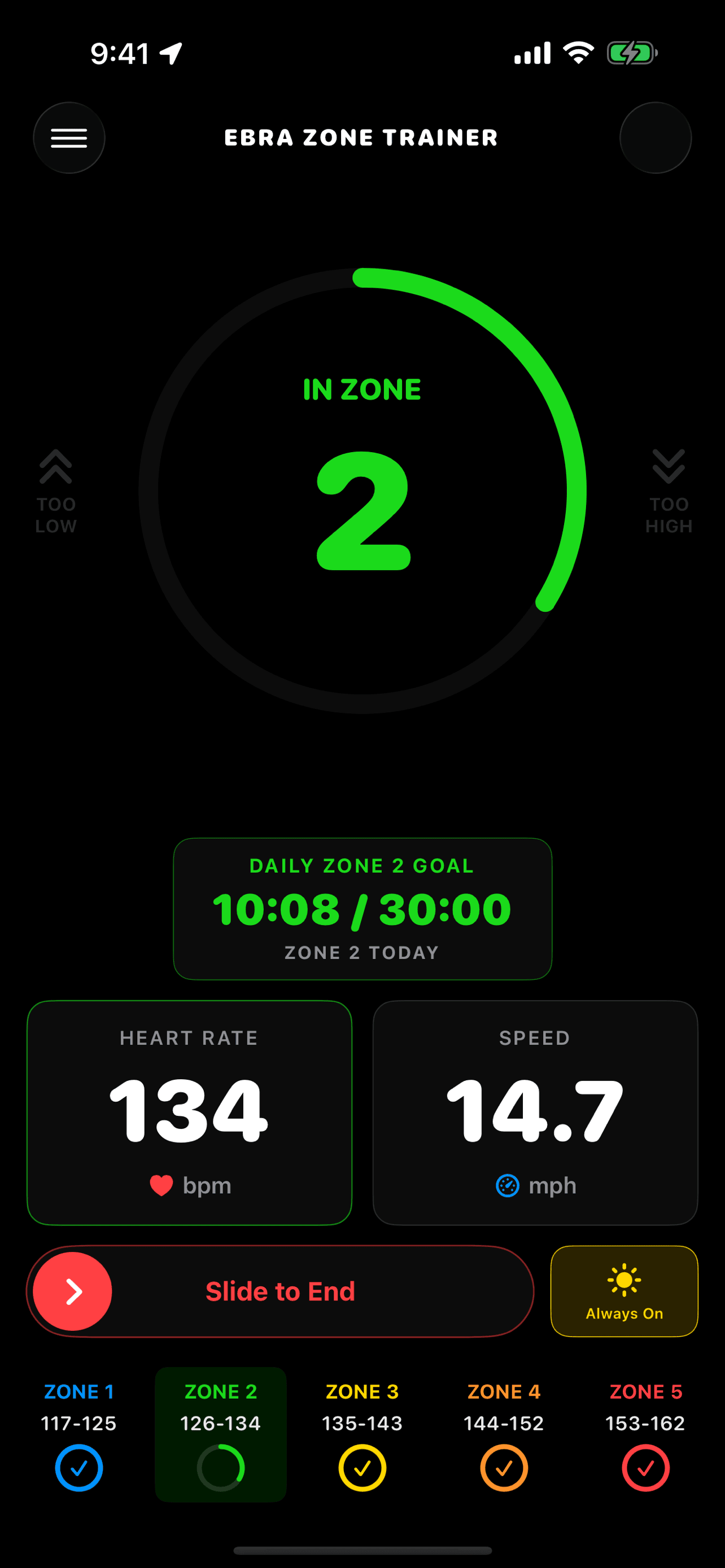
Free for iPhone and Android
Make your effort visible with EBRA Zone Trainer
Speed is a poor measure of effort on an e-bike because pedal assist changes the relationship between speed and human work. EBRA Zone Trainer focuses on the metric that matters for this workout: the rider's heart rate.
- Large color-coded display for below target, in zone, or above target
- Audio cues when the rider moves outside the selected zone
- Daily time-in-zone goals and workout history
- Apple Watch and standard Bluetooth heart-rate monitor support on iPhone
- Wear OS and standard Bluetooth heart-rate monitor support on Android
- No account, ads, subscription, or advertising tracking
iPhone
Scan with an iPhone camera or open the App Store link.
 Download for iPhone
Android
Scan with an Android camera or open the Google Play link.
 Download for Android
More routes mean more opportunities to train
This may be the e-bike's biggest practical advantage for Zone 2.
A rider on a conventional bicycle may need to find a flat route that matches the intended effort. Depending on where that rider lives, the route may be inconvenient, repetitive, crowded, or nonexistent.
Adjustable assistance can make rolling roads, hilly neighborhoods, country routes, and mixed-terrain paths usable for controlled aerobic riding. That can help people:
- Train near home instead of driving to a flat trail.
- Ride with fitter friends without being forced into an excessively hard effort.
- Adapt the same route for easy days, moderate days, and harder workouts.
- Compensate for heat, headwinds, cargo, fatigue, or changing fitness.
- Complete longer sessions with more confidence that they can get home.
- Keep riding as age, injury, or health changes alter physical capacity.
The best theoretical workout is useless if the rider cannot perform it consistently. A tool that expands route choice and makes the session easier to repeat can have substantial real-world value.
"E-bikes do not provide real exercise."
The research does not support that blanket statement.
A systematic review of 17 studies found moderate evidence that pedal-assisted cycling provided physical activity of at least moderate intensity. The intensity was generally lower than conventional cycling but higher than walking, and the review also found moderate evidence of improved cardiorespiratory fitness among physically inactive people.
In a four-week real-world commuting study, previously sedentary participants rode pedal-assist bikes at a self-selected moderate intensity and improved measured aerobic fitness, exercise power, and glucose response.
A large survey across seven European cities found similar total travel-related physical activity among e-bike riders and conventional cyclists. E-bike riders traveled farther, helping compensate for lower effort per mile.
None of that means an e-bike automatically creates a good workout. A rider can select maximum assistance and contribute very little. The point is that assistance is adjustable.
Turn it down when your body needs to do more. Turn it up when terrain is forcing your body to do more than the workout calls for.
How to perform a Zone 2 e-bike ride
- Choose a realistic target. Use an individualized heart-rate range when available, and combine it with breathing, perceived effort, and the talk test.
- Warm up gradually. Spend roughly 10 minutes at an easy effort before settling into the main session.
- Use the lowest assist that supports the target. The goal is not maximum assistance. It is the correct amount of assistance.
- Adjust before the hill wins. Heart rate responds with a delay, so increase assistance early instead of waiting until effort has already spiked.
- Reduce assist on easier terrain. If heart rate falls below target, ask your body to contribute more.
- Accumulate steady time. Focus on a sustainable session, not a perfect graph or a speed record.
Heart-rate numbers require context. Temperature, dehydration, fatigue, stress, caffeine, illness, and medications can change heart-rate response. People with cardiovascular conditions, significant health concerns, or medications that affect heart rate should seek individualized guidance from a qualified healthcare professional.
Here is what both kinds of cyclists can agree on
Traditional bicycles are excellent fitness tools. They build endurance, strength, skill, and speed. For racing, maximum-effort climbing, or training specifically for human-powered cycling performance, an unassisted bike may be the more appropriate tool.
But it is not the best tool for every workout or every rider.
An e-bike offers a form of workload control that a traditional bicycle does not. The same bike can support a recovery ride, a steady aerobic session, a harder interval workout, a commute, or a social ride with friends of different abilities.
That versatility is not a weakness. For many people, it is one of the strongest fitness arguments for owning an e-bike.
Final thoughts: easier bicycle or smarter training tool?
An e-bike can certainly make riding easier.
It can also make exercise more controlled, accessible, repeatable, and practical.
For Zone 2 riders, the motor can prevent hills from dictating the intensity of the workout. Instead of searching for the rare route that is flat enough, riders can use assistance to make more of the roads around them suitable for steady aerobic work.
So when someone says an e-bike cannot provide a serious workout, the answer is simple:
The motor does not choose the workout. The rider does.
And when the workout calls for controlled, sustainable effort, having control over that motor may make the e-bike the better tool.
Research and supporting sources
- Health benefits of electrically-assisted cycling: a systematic review. International Journal of Behavioral Nutrition and Physical Activity, 2018.
- Pedelecs as a physically active transportation mode. European Journal of Applied Physiology, 2016.
- Physical activity of electric bicycle users compared to conventional bicycle users and non-cyclists. Transportation Research Interdisciplinary Perspectives, 2019.
- Pitchfork-bifurcation-based competitive and collaborative control of an e-bike system. Research demonstrating e-bike assistance as a way to regulate physiological measures such as heart rate.
- WHO Guidelines on Physical Activity and Sedentary Behaviour. General adult physical-activity recommendations.